

How to Think in German Without Translating Every Word
Understand why you pause when speaking German and practise responding naturally with short stories and real-life dialogues.
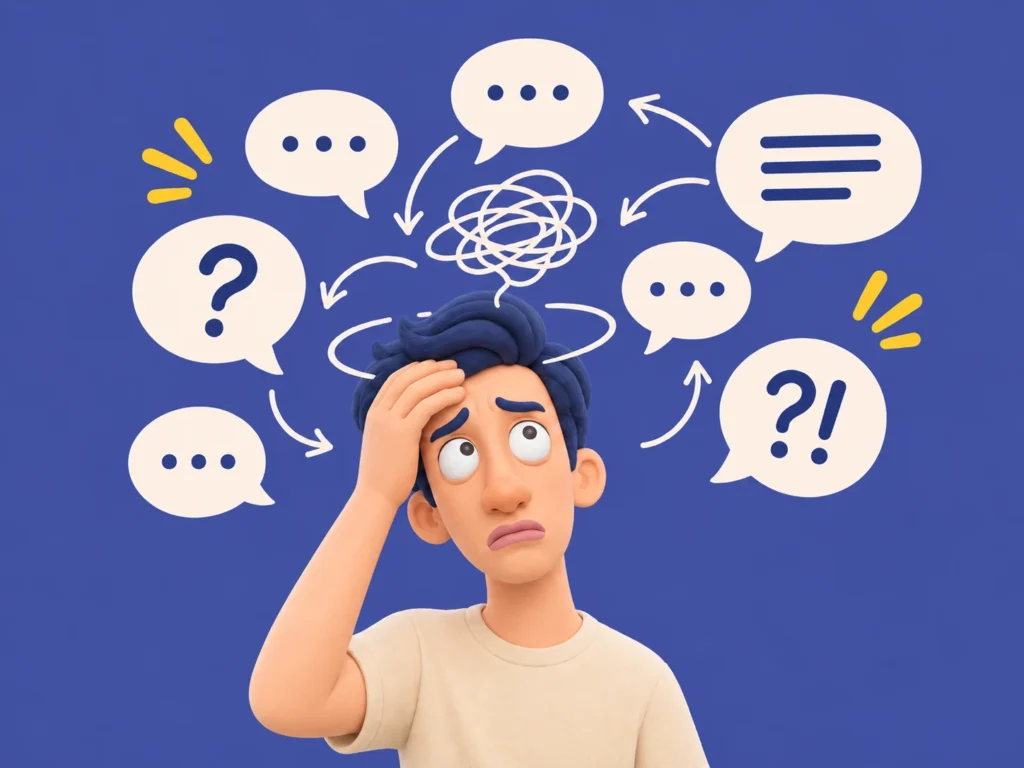
“Kannst du morgen einspringen?” Your colleague asks whether you can cover a shift tomorrow. You understand the question. You even know the answer. But before you say anything, your thoughts run through another language: Can I? How do I say I already have plans? What tense do I need? By the time you are ready, the moment feels awkward.
This is the frustration behind the question “How can I think in German instead of translating?” The useful goal is not to erase your first language. It is to make familiar German responses easier to retrieve when you need them—without constructing every sentence from scratch.
To work toward that goal, we will examine the pause itself, practise ready-to-use expressions in realistic conversations, and turn short German stories into opportunities to respond spontaneously.
Table of Contents
- What Does “Thinking in German” Actually Mean?
- A Pause Does Not Always Mean You Are Translating
- From Translation to a Ready German Response
- Use a Short Story as a Conversation, Not Just a Text
- What If the German Word Is Missing?
- A Realistic Practice Habit: Respond, Change, Return
- Keep Building Your Spoken German
- Research and Further Reading
What Does “Thinking in German” Actually Mean?
People use the phrase in different ways. Sometimes they mean recognising die Rechnung without silently saying “the bill.” Sometimes they mean describing a scene in German. Often, they mean being able to answer a question before mentally translating a complete sentence.
These are related, but they are not identical skills. A practical definition is: you can connect a situation or intention with a German expression you already know, instead of first assembling the message in another language.
“I cannot come” → translate each part → “Ich kann nicht kommen.”
You need to decline → “Ich kann leider nicht.”
Neither path is morally better. Translation can be a helpful learning tool. The second path is simply more convenient when a familiar social situation requires a quick answer.
There is also a scientific reason not to treat the first language as an enemy. A 2026 eye-tracking study on bilingual word recognition found cross-language competition for spoken words under its experimental conditions. That does not mean every bilingual person consciously translates while speaking. It does show why a simple “switch off your native language” rule does not accurately describe bilingual processing.
A Pause Does Not Always Mean You Are Translating
Imagine you hesitate before saying “Ich habe schon etwas vor.” You may be searching for the verb, deciding how polite to sound, planning the next sentence, or worrying about a mistake. None of these is necessarily a literal translation problem.
Research treats spoken fluency as more than speed. For example, a 2020 study of second-language fluency examined the contribution of word retrieval, grammatical encoding and first-language speaking patterns. Different kinds of hesitation had different relationships with these processes.
That distinction changes the practice strategy. If you lack a word, learn a useful phrase. If you know it but cannot produce it quickly, practise retrieving it aloud. If you hesitate because you need more thinking time, learn how to keep the conversation going.
The Council of Europe’s CEFR speaking descriptors recognise that speakers at different levels pause, reformulate and use routines to maintain communication. Being able to continue a conversation matters more than never hesitating.
From Translation to a Ready German Response
Return to the opening question:
Kollegin: „Kannst du morgen einspringen?“
Du: „Leider nicht, ich habe schon etwas vor.“
Kollegin: „Alles klar. Danke trotzdem!“
Instead of learning an English-to-German translation for every possible answer, notice three reusable parts: leider nicht (a gentle refusal), ich habe schon etwas vor (you have plans), and danke trotzdem (thanks anyway).
They are not interchangeable with every other phrase. Their value comes from the situation they belong to. The next time someone asks for help, you can adjust a familiar response:
- „Heute geht es leider nicht.“
- „Ich kann erst am Nachmittag.“
- „Morgen passt es mir besser.“
- „Ich sage dir später Bescheid.“
This is thinking with German building blocks, not memorising long scripts. You recognise the conversational purpose and select a phrase that fits it.
A 2025 study on multiword expressions and perceived fluency found that frequent word sequences contributed a small but measurable amount to listeners’ fluency judgments after other speech features were considered. The participants were Japanese learners of English, so the result does not measure the effectiveness of our German examples. It does support taking familiar, reusable phrases seriously.
Use a Short Story as a Conversation, Not Just a Text
German stories give you a context before you have to speak: you know who the people are, what they want and why they react. A short scene can then become an unscripted speaking prompt.
Read this original practice scene. It was written for this article, not taken from an existing Language Through Story story:
Mara: „Ich habe gerade erfahren, dass das Konzert ausfällt.“
Jonas: „Ach, schade. Was machen wir jetzt?“
Mara: „Wir könnten trotzdem in die Stadt fahren.“
Jonas: „Gute Idee. Ich kenne ein ruhiges Café in der Nähe.“
Now imagine Jonas asks you: „Was machen wir jetzt?“ Before looking at the examples below, answer aloud with one complete sentence in German. It does not need to be sophisticated.
Show possible responses
- „Wir könnten spazieren gehen.“
- „Wie wäre es mit einem Café?“
- „Lass uns etwas anderes machen.“
Try a different answer as well. The goal is to respond to the situation, not copy the example perfectly.
Next, change one detail: the concert is not cancelled; it starts an hour late. What would you say now? This small variation stops the practice from becoming a recited script.
You can run the same activity with longer stories. Pause after a character asks a question, hide the transcript and answer as if you were in the scene. Then return to the actual dialogue to compare your response with the story.
What If the German Word Is Missing?
Not knowing one word does not have to end your sentence. Describing what you mean is itself a useful communication skill.
Suppose you cannot remember der Reißverschluss (zipper). You might say:
„Wie heißt das Teil an der Jacke, das man auf- und zumachen kann?“
Or, if you need a moment:
- „Wie sagt man das auf Deutsch?“
- „Ich meine das Ding, mit dem man …“
- „Mir fällt das Wort gerade nicht ein.“
- „Anders gesagt: …“
These are not embarrassing emergency phrases. They keep your message moving while you search for the precise word. Over time you can replace a description with the exact expression when you learn it.
The most useful improvement is often not a faster word-for-word translation, but a simpler message you can already express.
A Realistic Practice Habit: Respond, Change, Return
Choose one short dialogue or story scene. Give yourself a real reason to speak: answer a question, disagree politely, make a suggestion or explain a decision. Keep the first answer short. Then change one detail and answer again.
For example, start with „Hast du heute Abend Zeit?“ Your first answer might be „Ja, ab sieben.“ Change the situation—now you are busy until nine—and try again: „Vor neun schaffe ich es leider nicht.“
Return to the same situation another day, but use a slightly different answer. In a 2024 study of spaced speaking practice, learners of English improved on measured fluency outcomes after repeated training sessions. The study compared different spacing conditions; it did not establish a universal number of minutes or a German-specific routine. It nevertheless supports the idea that actual speaking practice, repeated over time, deserves a place alongside reading and listening.
Sometimes you will still translate. That is not a failure. When you learn a difficult grammatical distinction, compare formal expressions or need precision, deliberate translation may be useful. The aim is to have more ways to communicate, not to ban one learning strategy.
Keep Building Your Spoken German
Thinking in German becomes easier to practise when the language is connected to familiar situations. Stories and dialogues provide those situations; speaking turns them into something you can use.
For related learning strategies, read our article about learning German vocabulary in context and our guide to German listening comprehension with stories. You can also explore German stories and interactive learning at Language Through Story.
The next time a simple question catches you off guard, do not ask yourself how to translate an entire perfect sentence. Ask: What is the shortest natural German answer I already know? Say that first. Then build on it.
Research and Further Reading
- Hendrickson et al. (2026) – Language nonselective lexical access in bilinguals: Input modality matters. Research on bilingual word recognition; does not measure conscious translation in conversation.
- Takizawa & Suzuki (2025) – The role of multiword sequences in fluent speech. Study on the contribution of recurring word sequences to perceived L2 fluency.
- Kakitani & Kormos (2024) – The effects of distributed practice on second language fluency development. Study of repeated oral fluency training in learners of English.
- Council of Europe – CEFR qualitative aspects of spoken language use. Official descriptors of interaction, fluency and hesitations.
- Kahng (2020) – Explaining second language utterance fluency. Research on cognitive and L1 contributions to fluency.