


Learn German Vocabulary in Context with Stories (B1–B2)
Learn German expressions in context with stories, complete sentence examples and a repeatable six-step practice routine.
Table of Contents
- What Does “Learning Vocabulary in Context” Mean?
- Why Stories and Dialogues Are Useful
- A German Mini-Story: Five Expressions Worth Learning
- A 6-Step Method for Learning Vocabulary from Stories
- German Details Worth Saving with Each Expression
- B1 or B2: What Should You Focus On?
- Mini Practice: Can You Use the Expressions?
- Mistakes That Make Vocabulary Harder to Remember
- Make Vocabulary Learning Part of Your Story Routine
- Frequently Asked Questions
- Final Thoughts
- Sources and Further Reading
You recognise many German words when you read, but they do not always come to mind when you need them. Maybe you know that verschieben means “to postpone”, yet hesitate when you want to say “postpone an appointment”. Or you understand Bescheid geben in a story but rarely use it in conversation.
At B1 and B2, knowing more individual words is only part of the challenge. You also need to know which words belong together, which grammar they require, and how people use them in real situations.
Learning German vocabulary in context means working with words inside meaningful sentences, stories and dialogues—not just memorising a translation. This guide gives you a concrete example and a practical routine you can use with your next German story.
What Does “Learning Vocabulary in Context” Mean?
A vocabulary list may tell you that die Entscheidung means “decision”. A story can show you how the word is actually used:
Isolated word: die Entscheidung — decision
In context: „Nach langem Überlegen traf sie eine Entscheidung.“
Now you see a common combination: eine Entscheidung treffen — “to make a decision”. You also see a sentence pattern you can reuse.
A useful vocabulary note can contain four things:
- Meaning: What does the word or phrase mean here?
- Form: Is it a noun with an article, a separable verb, or a reflexive expression?
- Combination: Which other words commonly appear with it?
- Situation: When would a speaker naturally use it?
The context does not tell you everything about a word. You may still need a dictionary to check another meaning, a preposition or a grammatical form. But it gives you a place to start.
Why Stories and Dialogues Are Useful
Stories provide characters, intentions and consequences. Those details give unfamiliar expressions a reason to appear. Dialogues add a second advantage: they show how people react to one another.
Consider Bescheid geben. The translation “let someone know” is useful. A short scene is more memorable:
„Der Zug hat Verspätung“, sagte Elena. „Ich gebe meiner Kollegin sofort Bescheid.“
You can infer that Elena is informing her colleague because she will be late. You also encounter the grammar: jemandem Bescheid geben. The person being informed appears in the dative: meiner Kollegin.
A 2025 meta-analysis of extensive reading in second- and foreign-language learning found positive effects across several language domains, including vocabulary. It studied reading programmes in different learning contexts—not Language Through Story specifically and not a guarantee that every new word will stick after one story.
A German Mini-Story: Five Expressions Worth Learning
Read the scene first. Resist the urge to translate every word immediately.
Eine unerwartete Verspätung
Am Montagmorgen musste Elena einen wichtigen Termin verschieben. Ihr Zug hatte Verspätung. Deshalb gab sie ihrer Kollegin sofort Bescheid und schlug ein neues Treffen vor. Ihre Kollegin hatte Verständnis. Schließlich einigten sie sich auf einen Termin am Nachmittag.
Original practice scene created for this article; not an excerpt from a published LTS story.
Here are five useful chunks from that scene:
| Expression | Meaning | Reusable example |
|---|---|---|
| einen Termin verschieben | to reschedule an appointment | Können wir den Termin verschieben? |
| Verspätung haben | to be delayed | Mein Zug hat Verspätung. |
| jemandem Bescheid geben | to let someone know | Ich gebe dir heute Abend Bescheid. |
| Verständnis haben | to be understanding | Danke, dass du Verständnis hast. |
| sich auf etwas einigen | to agree on something | Wir haben uns auf Freitag geeinigt. |
Notice what makes these more helpful than isolated words. You learn the article in einen Termin, the dative in dir Bescheid geben, and the combination sich auf etwas einigen. Those details matter when you want to speak or write German yourself.
A 6-Step Method for Learning Vocabulary from Stories
This is a practical study routine, not a scientifically fixed formula. Try it with one short scene from a B1 or B2 story.
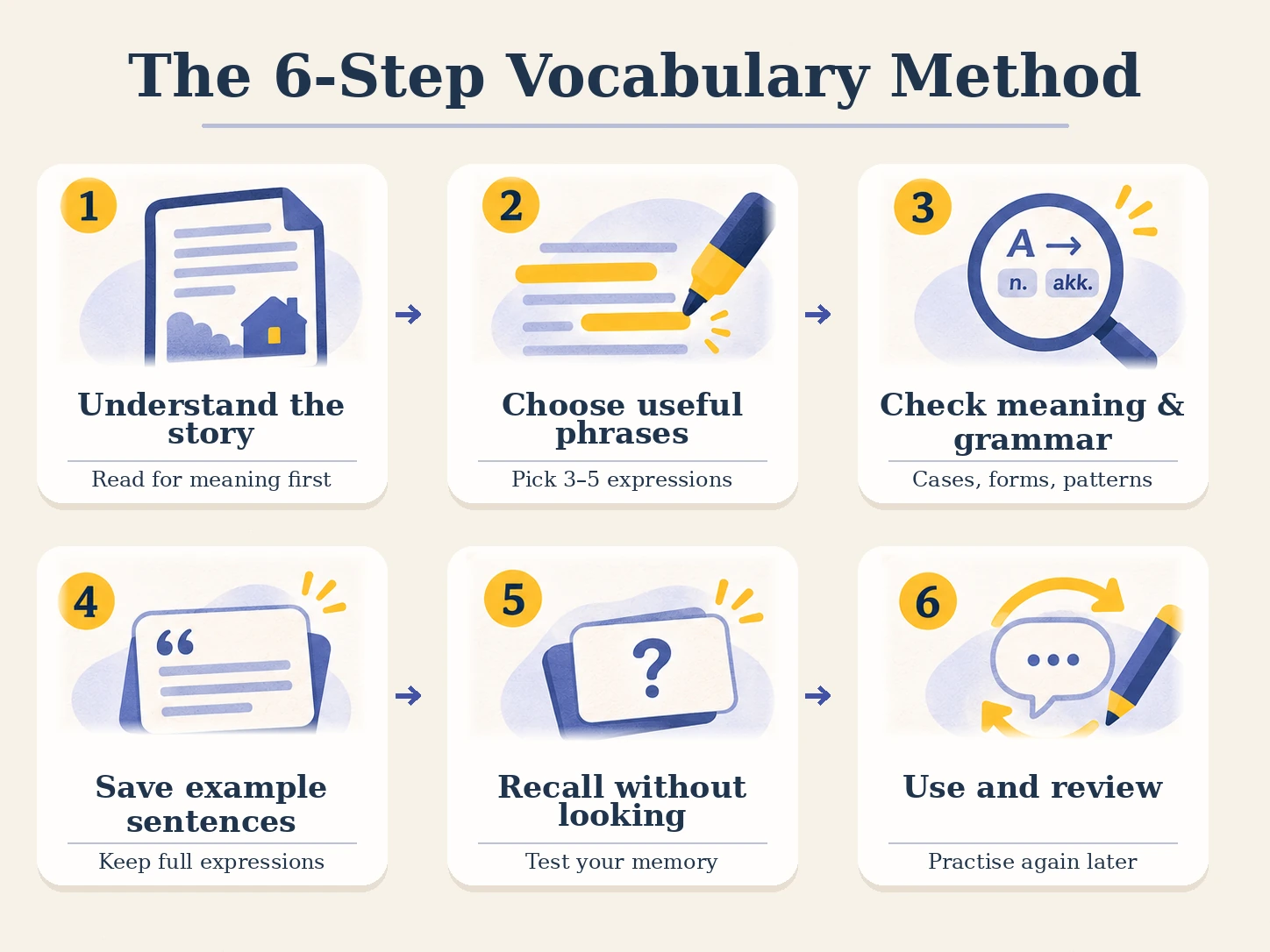
1. Read for the Situation, Not Every Word
Read the paragraph once for meaning. Who is involved? What changed? What is the problem? In Elena’s story, an unexpected delay forces her to change a meeting. This context is the foundation for understanding the vocabulary.
2. Select a Few Useful Phrases
Choose three to five expressions that are relevant to your own life. Avoid saving every unfamiliar word. A phrase you can imagine using tomorrow deserves attention; a rare detail may not.
3. Check Meaning and Grammar
Guess from the scene, then verify your guess. Note the article, plural or verb structure when relevant. For example, don’t just store einigen; keep sich auf etwas einigen and an example sentence.
4. Save Complete Examples
Instead of a card showing only verschieben = postpone, save einen Termin verschieben with „Wir müssen den Termin verschieben.“ Full examples show where the expression belongs in a sentence.
5. Recall Before Looking
Cover the answer and try to retrieve the expression: “How do I say ‘let someone know’?” Then check Bescheid geben and try a sentence with dir or meiner Kollegin. Retrieval gives you practice producing the language, not just recognising it.
6. Reuse It in a New Situation—and Revisit It
Imagine your own situation: a delayed train, a changed plan or a missed meeting. Write or say two original sentences. Review the phrases again after a gap rather than repeating them all in one sitting.
Research perspective: A 2022 study on vocabulary learning during reading found that encountering target words in meaningful story contexts supported retention compared with words not encountered there. A 2021 classroom study also identified spacing as an important predictor of longer-term retention in deliberate vocabulary study. These findings support combining meaningful exposure with later practice; they do not prescribe one exact review schedule for all learners.
German Details Worth Saving with Each Expression
Articles and Plurals
For nouns, keep the article with the word: der Termin, die Verspätung, das Treffen. Add a plural when it is relevant: die Termine, die Treffen. This makes later sentence-building easier.
Verbs with Prepositions and Cases
German expressions often need a particular preposition or case. Learn sich auf etwas einigen rather than einigen alone. Learn jemandem Bescheid geben rather than Bescheid alone.
Collocations and Everyday Phrases
Some combinations are especially natural: eine Entscheidung treffen, einen Vorschlag machen, Verständnis haben. If you learn the whole combination, you are less likely to translate word for word from another language.
Register: Does It Fit the Situation?
Compare „Gib mir Bescheid“ (common and informal) with „Bitte informieren Sie mich“ (more formal). Both can communicate a similar intention, but they suit different contexts. Stories and dialogues can help you notice that distinction.
B1 or B2: What Should You Focus On?
At B1, prioritise useful everyday expressions you will need for familiar situations: appointments, work, travel, relationships and plans. Practise making a short, clear sentence with each expression.
At B2, pay more attention to nuance, paraphrasing and typical combinations. For example, compare „einen Vorschlag machen“, „etwas vorschlagen“ and „etwas in Betracht ziehen“. They are related, but they are not interchangeable in every sentence.
The Council of Europe’s CEFR descriptors distinguish vocabulary range and control across levels. A level label is a guide, though: choose expressions you can understand and actually use, rather than collecting difficult words only because they look advanced.
Mini Practice: Can You Use the Expressions?
Complete these sentences from memory before checking the answers.
- Mein Zug hat ________. Ich komme später.
- Können wir unseren Termin auf morgen ________?
- Ich gebe dir heute Abend ________.
- Wir haben uns auf Montag ________.
Show the answers
- Verspätung
- verschieben
- Bescheid
- geeinigt
Extra challenge: Write one original sentence using Verständnis haben.
Mistakes That Make Vocabulary Harder to Remember
- Saving too many words: A huge list is difficult to review consistently. Keep a small selection of high-value expressions from each story.
- Recording translations without examples: A single translation rarely shows the correct preposition, case or natural combination.
- Confusing recognition with recall: Recognising a word in a story does not mean you can produce it in conversation. Test yourself without looking.
- Never returning to a phrase: Reading it once may help you understand that scene, but later encounters and review create more opportunities to remember it.
- Studying with no personal connection: Make at least one sentence about your own plans, experiences or work.
A 2019 meta-analysis found a positive relationship between repeated encounters and incidental second-language vocabulary learning, with considerable variation depending on learners and tasks. Repetition matters, but there is no universal number of exposures that guarantees mastery.
Make Vocabulary Learning Part of Your Story Routine
A realistic routine might be: read a story for enjoyment; select a handful of phrases; check how they are used; revisit them with flashcards; then use two of them in a new sentence or short dialogue. This is a suggested workflow, not a required number of minutes or cards.
On Language Through Story, the interactive texts include word explanations and the platform offers vocabulary saving, pronunciation and flashcard review. The stories and dialogues also give you contexts in which those expressions naturally appear.
If you prefer to begin with free materials, explore the German story and dialogue playlists. For guided vocabulary review and the full learning tools, see the membership options.
Frequently Asked Questions
Is it better to learn German vocabulary in sentences or word lists?
Word lists can help with quick review, but sentences show grammar, common combinations and situations. A practical approach combines a short example sentence with later recall practice.
How many new expressions should I collect from one story?
There is no fixed number. As a manageable starting point, try three to five expressions you expect to use, then adjust depending on the story and your review time.
Should I translate every unknown German word?
No. First try to understand the passage. Check words that block the meaning or are especially useful. A dictionary is valuable for verifying your guess and the grammatical form.
Do flashcards work for learning German in context?
They can help you recall vocabulary between readings. Make cards that include a phrase or example sentence, and return to the expressions in stories and actual conversations.
Can I learn B2 vocabulary by reading German stories?
Stories can help you encounter B2-level expressions, but active use matters too. Read varied topics and practise explaining ideas, paraphrasing and using new expressions appropriately.
Final Thoughts
German vocabulary becomes more useful when you know not just what a word means, but how it behaves in a sentence and when you would say it. A story gives the first encounter a situation; careful notes, recall and reuse help turn that encounter into something you can draw on later.
Start with one short scene. Choose a few phrases. Check them, say them, and return to them. Build your German vocabulary around language you can actually use.
Sources and Further Reading
- Sangers et al. (2025), Learning a Language Through Reading, Educational Psychology Review — meta-analysis of extensive reading and language learning.
- Van den Broek et al. (2022), Vocabulary Learning During Reading: Benefits of Contextual Inferences Versus Retrieval Opportunities, Cognitive Science — contextual reading and vocabulary retention.
- Pauwels (2021), Effectiveness in L2 Vocabulary Study, Canadian Journal of Applied Linguistics — spacing and deliberate vocabulary study.
- Uchihara, Webb & Yanagisawa (2019), The Effects of Repetition on Incidental Vocabulary Learning, Language Learning — meta-analysis of repetition effects.
- Council of Europe, CEFR descriptors — reference for B1/B2 language competences.